
Search “why are people choosing [any company]” in almost any industry and you’ll usually find a mixture of customer experience, company marketing and third-party coverage. Those are useful sources of information, but they are not the same thing.
There is no public market-share or switching dataset used in this article that proves a broad movement of miners from other hosting providers to OneMiners. Instead, this article looks at the practical factors that can make one mining host more attractive than another, then examines how OneMiners describes its own offering and how outside coverage discusses the company.
What Actually Matters When Comparing Mining Hosts

Before looking at claims about OneMiners specifically, it helps to define the criteria that can materially affect a hosting customer’s experience and economics.
All-in electricity cost. Compare the actual cost of running the miner, including the electricity rate, hosting charges and any additional fees rather than only the headline per-kWh figure.
Deployment and onboarding. Ask how long it normally takes from payment or hardware arrival until the ASIC is installed, configured and hashing.
Performance visibility. A dashboard that shows hashrate, uptime and machine status gives customers more direct visibility into how their hardware is operating.
Support and maintenance. Find out how outages, repairs and hardware problems are handled, how quickly support normally responds and what costs the customer may be responsible for.
Contract clarity. Pay particular attention to repair billing, curtailment, payment terms, hardware removal and early-exit conditions.
Ability to scale. Buyers planning to add machines later should ask whether additional units can be deployed under the same pricing and operating conditions.
These criteria do not prove that one provider is universally better than another. They provide a consistent framework for comparing OneMiners with whichever alternatives you are actually considering.
What OneMiners Says About Why Customers Choose It
OneMiners has published its own account of why it considers itself the world’s best mining company in 2026. It’s worth reading directly to see which of the factors above the company itself emphasizes — pricing, uptime, facility location, or something else. As with any company-authored content, treat it as a statement of what OneMiners wants to highlight about itself, not as independent proof. The useful exercise is to take whatever it claims and ask OneMiners directly to back it up with specifics: actual current rates, actual uptime data, actual onboarding timelines.
What External Comparison Articles Say — And How Much Weight to Give Them

Several TechBullion articles discuss OneMiners alongside other mining companies, including Top 5 Crypto Mining Platforms Compared: Why OneMiners Wins in 2026, Test of Top 5 Crypto Mining Companies in the US, and a case study describing OneMiners as a leading crypto-hosting company.
These articles are useful for seeing which features and metrics are being attributed to OneMiners, but publication on a third-party website does not automatically make a comparison independent. The coverage is strongly favorable toward OneMiners and makes substantial claims about pricing, uptime, deployment, optimization and competitive position.
For that reason, use the articles as external coverage rather than independent validation. When a comparison makes a strong claim, check:
• What methodology is actually described? Was hardware or hosting used over time, or were published specifications and rates compared? • Can the underlying figures be reproduced? Check electricity rates, ASIC specifications and profitability with current data. • Are the same claims available from another source? A company feature should ideally be confirmed through contracts, live pricing, dashboard information or customer documentation. • Is there a commercial disclosure? Check whether the article identifies sponsorship, affiliate relationships or another material connection. • How current is the information? Hosting rates, hardware economics, network difficulty and company policies can all change.
The important distinction is between coverage and verification. A favorable article can identify claims worth investigating, but it should not by itself prove that OneMiners outperforms every alternative.
A Concrete OneMiners Differentiator: Prepaid Energy
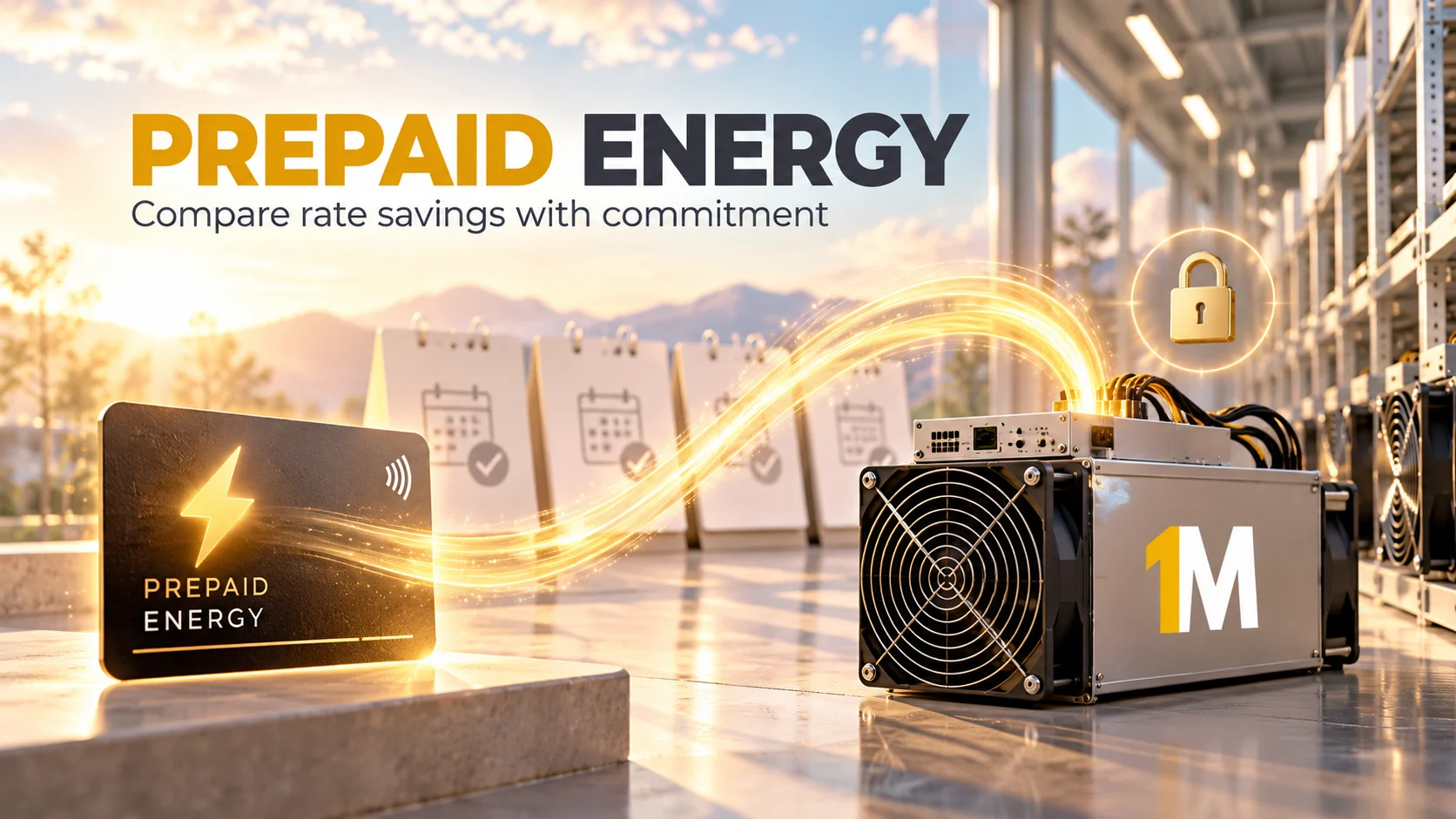
One feature that does distinguish OneMiners’ current hosting model is Prepaid Energy. Instead of paying only the standard ongoing electricity rate, eligible customers can prepay energy for a selected period in exchange for a lower fixed per-kWh rate.
The Medium article Prepaid Energy: How to Lock In a Discounted Power Rate Before You Ever Plug In walks through the structure using a real account example, including shorter and longer lock-in periods and the tradeoff between paying more capital upfront and reducing the electricity rate.
OneMiners’ own current materials also describe Prepaid Energy as an active platform feature. Published terms show that longer commitments receive larger discounts, with one-, three- and seven-year options available in its current pricing structure.
That can be economically meaningful because electricity is one of the largest recurring mining expenses, but a lower fixed rate does not automatically make a long-term prepayment the better choice. The customer gives up liquidity and takes on commitment risk in exchange for price certainty. Before choosing a prepaid plan, confirm the exact rate, total upfront payment, contract duration, what happens if the ASIC fails or is replaced, whether unused energy can transfer to another machine, and what happens if you leave the facility early.
How to Verify Any of This Yourself

Rather than taking either OneMiners’ own claims or third-party rankings at face value, here’s how to actually check:
- Get OneMiners’ current hosting rate and fees in writing, and compare them against at least one or two competitors quoting the same machine and contract length.
- Ask about their power procurement strategy — spot rate, prepaid, or contracted — and how long any favorable rate is locked in for.
- Check independent review platforms (not company-published testimonials) for patterns in onboarding speed, support responsiveness, and contract disputes.
- Run your own breakeven calculation using a live mining profitability calculator with OneMiners’ actual quoted numbers, rather than relying on a third-party article’s stated ROI.
- Ask whether customer references are available, but remember that company-provided references are selected by the provider. Compare what they tell you with recent third-party reviews and, where possible, independently identified customers or community discussions.
Be Skeptical of Implied Popularity
One subtle pattern worth watching for in marketing content is the implication that “everyone” or “most people” are choosing a company, without any actual numbers behind it. Phrases like “people are switching to X” or “the clear winner” can be true, but they can also be a rhetorical device used regardless of actual market share. If a claim about popularity matters to your decision, ask for something concrete — actual customer counts, actual growth data, or actual independent review volume — rather than accepting the framing at face value.
Frequently Asked Questions
Is OneMiners actually the best mining hosting company? “Best” depends on the criteria that matter to you — price, uptime, support, contract flexibility — and how OneMiners performs on those specific factors compared to alternatives you’re actually considering. Independent verification matters more than any single superlative claim, including ones in this article’s sources.
Are crypto “top 5” comparison articles trustworthy? They can be useful for discovering providers and comparison criteria, but don’t assume a ranking is independent simply because it appears on a third-party website. Check the article’s methodology, sources, publication date and any sponsorship or affiliate disclosure, then verify important claims against current pricing, contracts, customer feedback and your own profitability calculations..
What does prepaid energy have to do with hosting cost? A hosting provider that locks in a discounted power rate in advance may be able to offer more stable, lower pricing than one paying spot-market electricity prices. It’s a legitimate factor to ask about directly.
How do I know if a hosting provider’s claims about itself are accurate? Ask for specifics in writing — actual rates, actual uptime data, actual onboarding timelines — and compare them against independent reviews and your own calculations, rather than relying on the company’s own marketing content alone.
The Bottom Line
There are practical reasons a buyer may choose one mining hosting provider over another — cost, speed, transparency, and support chief among them. Whether OneMiners specifically earns a “why people choose it” answer depends on how it performs against those factors for your situation, verified independently, not just how it’s described in its own content or in comparison articles that may have a financial relationship with the company being praised. Read the sources below directly, ask the questions above, and let your own verified numbers make the decision.
Sources and Further Reading
• OneMiners: World’s Best Mining Company 2026 • Prepaid Energy: How to Lock In a Discounted Power Rate Before You Ever Plug In — Medium • Top 5 Crypto Mining Platforms Compared: Why OneMiners Wins in 2026 — TechBullion • Test of Top 5 Crypto Mining Companies in the US — TechBullion • Case Study: How OneMiners Became the World’s Best Crypto Hosting Company — TechBullion
#OneMiners #BitcoinMining #ASICMining #CryptoMining #MiningHosting #CryptoComparison #BitcoinHosting #CryptoDueDiligence